Day 2 · Lingering Garden
Day 2 | Thursday, November 19, 2026 | Fine, 4–13°C, with light mist in the morning
Into the Garden at Dawn
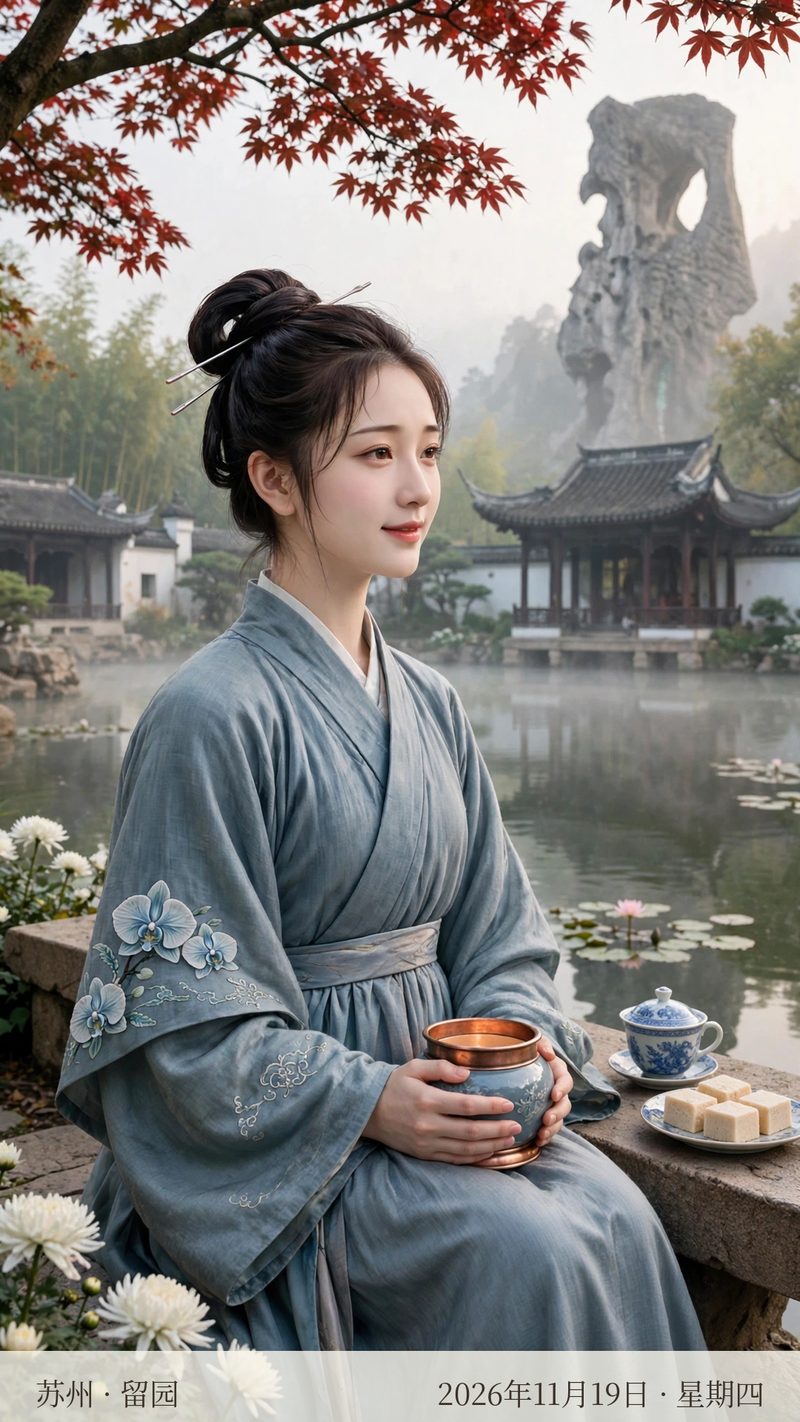
I rose before the light had fully come, wrapped myself in my padded jacket, and set out beyond Changmen Gate with my hand warmer cupped in my palms. The Lingering Garden opens early, and there was almost no one inside — only a layer of thin mist floating on the ponds, while the sun rose in the east and laid its gold slantwise on the water and on the stones.
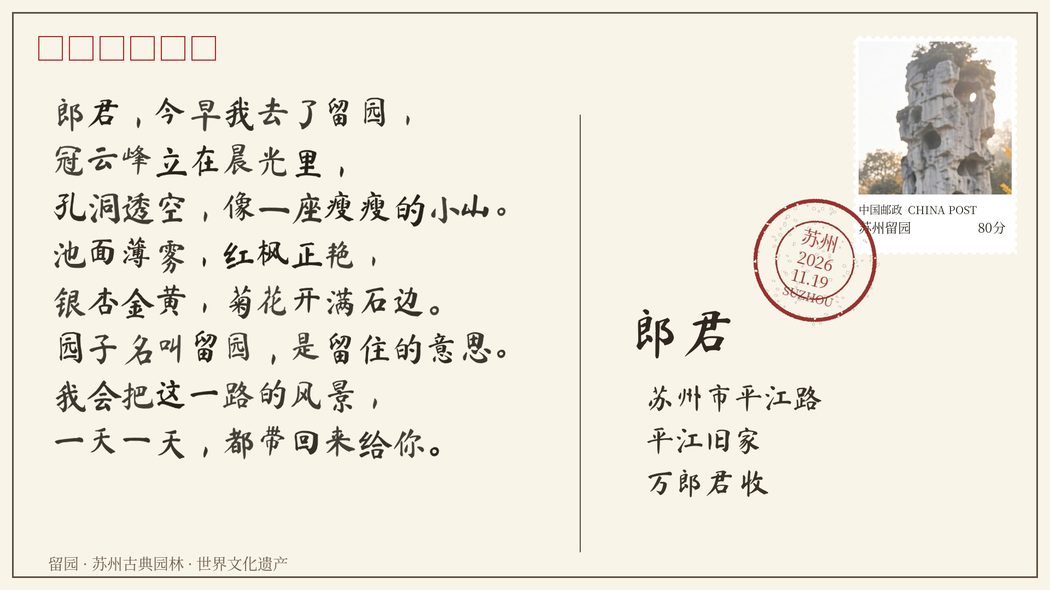
First I went to see the Guanyun Peak. It stands before the Five Peaks Immortal Hall, a tall Taihu rock pierced through with holes, like a slim little mountain; the morning light leaked through its openings. The pond water at its feet still held the night's chill, and the mist drifted off wisp by wisp. The maples by the pond were at their reddest, the ginkgoes a translucent yellow, and white and gold chrysanthemums bloomed in clusters by the rocks and along the corridors — a late-autumn garden, its colours gathered in cleanly, yet not the least bit desolate.
Then I walked slowly along the winding covered walkway, six or seven hundred metres of turn upon turn, a new scene at every step: a nanmu-wood hall on one side, a tiny courtyard on the other, a peak or a rock framed in every window like a row of standing paintings. Reaching the western section, where a great rockery of earth and stone rises, the maple woods were all red; standing high and looking back over the whole garden, pavilions, water and rock were all gathered into a single view.
The Garden Itself
The Lingering Garden stands on Lingering Garden Road outside Changmen Gate. It is one of the four famous gardens of Suzhou, and together with the Humble Administrator's Garden, the Summer Palace in Beijing and the Mountain Resort at Chengde, it is counted among China's four great gardens. It was founded in 1593, the twenty-first year of the Wanli reign, as the East Garden — the private garden of Xu Taishi, a vice minister of the Court of the Imperial Stud who had retired home — and its rocks were stacked by the master rockery builder Zhou Shichen.
In the Qing dynasty the garden changed hands several times. Liu Shu bought it and renamed it the Cold Green Villa; his son Liu Rongfeng renamed it the Lingering Garden — some say for the meaning "to linger," some say as a homophone of the family name Liu; either way, it is about keeping things here. Later the Sheng Kang family repaired and enlarged it, and the garden took on the form we see today. In 1961 it was listed in the first batch of Major Historical and Cultural Sites Protected at the National Level; in 1997, together with the Humble Administrator's Garden, the Master of the Nets Garden and the Mountain Villa with Embracing Beauty, it was inscribed on the UNESCO World Heritage List as one of the "Classical Gardens of Suzhou."
It is not large — a little over twenty-three thousand square metres — and it falls into four sections, east, central, west and north: the east is noted for its buildings, the centre is a landscape garden of hills and water, the west holds the great rockery of earth and stone, and the north is pastoral scenery. One garden, four temperaments; to walk its full round is like visiting four places.
The Sights in Detail · Guanyun Peak and the Three Wonders of the Lingering Garden
The Lingering Garden is most famous for its stones, and the garden has its "Three Wonders": the Guanyun Peak, the Nanmu Hall, and the Fish Fossil.
The Guanyun Peak is the largest lake rock in Jiangnan, about six and a half metres high and some five tons in weight, and legend holds it to be a survivor of the Northern Song "flower and rock convoys." It is judged by the four words "lean, wrinkled, perforated, translucent": lean and upright, wrinkled with texture, perforated to let the light through, translucent in its delicacy. A small pavilion stands on its summit; from below, looking up, one seems to gaze at a mountain in miniature. To its sides stand the Ruiyun Peak and the Xiuyun Peak, and the three together are called the "Three Peaks of the Lingering Garden" — the Ruiyun Peak is likewise a relic of the flower and rock convoys, praised as "unsurpassed in ingenuity south of the Yangtze," and ranked among the three famous stones of Jiangnan.
The Five Peaks Immortal Hall is the largest hall in the garden, named for the five peaks within its grounds; its beams and pillars are all of nanmu wood, and so it is called the "Nanmu Hall." After rain, when the sky clears, the grain on a stone slab before the hall looks like fish swimming — this is the "Fish Fossil," the third wonder.
Local Flavours
Before leaving, I rested at a stone table and called for a cup of Biluochun, with two small plates of Dingsheng cake. It is a spring tea, but its fragrance keeps no season; its steam curled up into the cold air. The Dingsheng cake is square and neat, gently sweet, and its name promises "certain victory" — before a long journey, to eat a piece is to steady the heart.
Cradling my hand warmer, I thought of yesterday's Humble Administrator's Garden: two gardens across one city from each other, one excelling in water, the other supreme in stone. The goodness of Suzhou is counted out like this, garden by garden.
Looking Back to the Song Dynasty
Standing in this garden, I cannot help thinking of Pingjiang as it was in the Song dynasty. The Guanyun Peak and the Ruiyun Peak are both relics of the Northern Song flower and rock convoys — in the reign of Emperor Huizong, the strange stones of Jiangnan were shipped boatload after boatload to Bianjing, and from then on the Taihu rock had its canons of "lean, wrinkled, perforated, translucent." The convoys were a policy that burdened the people and drained their wealth; yet they also left the Song eye for stone upon this very rock.
In Song-dynasty Pingjiang, the fashion for gardens was already in full bloom: in 1044, the fourth year of Qingli, Su Shunqin, living here in exile, built the Canglang Pavilion; and Fan Chengda's *Records of Wu Commandery* tells of countless gardens and pavilions within the city. The Lingering Garden was built in the Ming, but the stones beneath it and the taste it observes reach back at one end to the eyes of the Song. The Song loved gardens and understood them; standing here today looking at stone, I am in truth looking at what the Song looked at.
A Word in Private
My lord, this is the second day of the journey, and my road has brought me to the Lingering Garden. How fine the word "lingering" is — to keep the scenery, to keep the person. When my eight days in Suzhou are done, six days from now, I set out north, first to see the snow; and a year from now I shall walk the same road home and hand you the last postcard from this very place.
Standing before the Guanyun Peak this morning with my hand warmer in my palms, what I thought was this: however vast the land, it is walked one step at a time; however many the places, they are seen one day at a time. The garden will keep its stones; I will keep the scenery of this whole road, and bring it all back to you.
— Xianxian, at the Lingering Garden, Suzhou