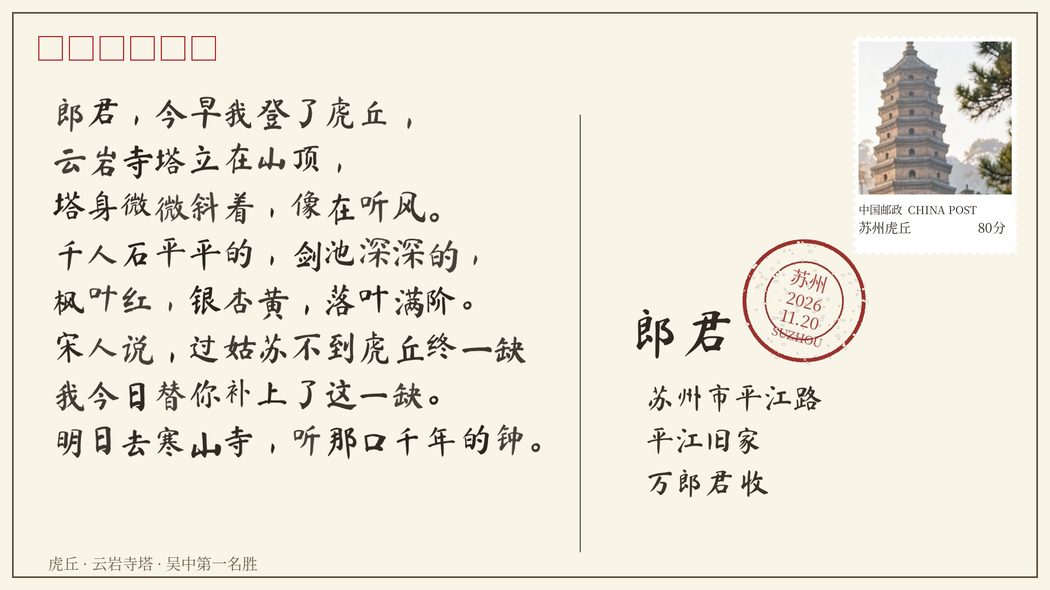
Day 3 · Tiger Hill

Key points: On November 20, 2026, the third stop of the journey, Xianxian climbed Tiger Hill in Suzhou to see the leaning silhouette of the Yunyan Temple Pagoda and the legends of the Thousand-Person Rock and the Sword Pool. Known as the finest scenic spot in the Wu region, Tiger Hill's pagoda dates from the Five Dynasties to the early Northern Song and is one of China's oldest surviving brick pagodas.
Day 3 | Friday, November 20, 2026 | Fine, 5–13°C, with clear morning light
Climbing the Hill at Dawn
I rose just as the sky began to lighten, put on my new aubergine padded jacket, pinned a chrysanthemum in my hair, and set out toward the north-west of the city. Tiger Hill is not far from the city wall, and the hill itself is not high — only a little over thirty metres — but once inside the gate the road climbs, with stone steps flanked by red maples and yellow ginkgoes, and a thin layer of fallen leaves rustling underfoot.
The morning light slanted in from the east, falling through the treetops onto the stone steps and onto the tower at the summit. The Yunyan Temple Pagoda stands on the hilltop, seven storeys, eight sides, its brickwork weathered by age, its crown leaning almost imperceptibly toward the north-west — from a distance the tilt is hard to see, but draw close and look up, and that slight inclination comes clear. The mist had not yet lifted from the hill, drifting in wisps around its waist, so that the whole hill looked as if it were only just waking from a dream.
I climbed slowly along the stone steps. The stones by the path were mossy, and ancient pines grew from the cracks in the rock, their branches gnarled. Halfway up lay a great flat stone, spread out like a natural stone bed — the Thousand-Person Rock.
The Hill Itself
Tiger Hill's fame is far greater than the hill itself. Legend says that King Helü of Wu was buried here in the Spring and Autumn period, and three days after the burial a white tiger crouched upon the tomb — from that tiger the hill takes its name. The hill is named for the tiger, the pagoda for the temple, and the Yunyan Temple Pagoda standing on the summit has become the most recognisable landmark outside Suzhou's walls.
Tiger Hill is also called the finest scenic spot in the Wu region. The hill is low, but its sights are crowded close together: the Sword Pool, the Thousand-Person Rock, the Sword-Testing Rock, the Hanhan Spring — a legend at every step. Gate, stone steps, ancient pines, pagoda — to walk the full round takes only half a day, yet its stories span two thousand years.
The hill stands in the north-western suburbs; in olden times it lay outside the city, though the city has since grown to its foot. The mountain paths were quiet in the early morning, with only the sound of fallen leaves being swept, and a few birds calling in the distance.
The Sights in Detail · The Yunyan Temple Pagoda and the Sword Pool
The Yunyan Temple Pagoda is the soul of Tiger Hill. It was built between 959, the sixth year of the Xiande reign of the Later Zhou, and 961, the second year of the Jianlong reign of the Northern Song — seven storeys, eight sides, forty-seven and a half metres high, and one of China's oldest surviving brick pagodas. It began to lean soon after it was finished; today its crown stands 2.34 metres from the centre line, a tilt of about 3.59 degrees, earning it the name of the "Leaning Tower of China" — the Leaning Tower of Pisa was built more than two centuries later, and it does not lean as early as this one does.
The pagoda is brick with wooden eaves; across a thousand years of wind and rain most of the wooden eaves have gone, yet the brick body still stands. In 1981 its underground chamber was discovered, yielding treasures such as a Yue-ware celadon lotus bowl and a gilt bronze Buddha — testimony to the incense and devotion it knew in the days of the Wuyue kingdom and the Northern Song.
Below the pagoda lies the Sword Pool, the most secluded spot on the hill. Its waters are cold and clear, too deep to see the bottom; legend says that at the bottom lies the tomb of King Helü, and in the tomb, the Fish-Intestine Sword. Another legend says that Gan Jiang and Mo Ye, husband and wife, forged swords here. On the cliff face beside the pool are carved the two great characters "Sword Pool," in the hand of the Tang calligrapher Yan Zhenqing, the strokes forceful and upright as a sword itself.
The Thousand-Person Rock lies beside the Sword Pool, its surface broad and flat. Legend says King Helü reviewed his troops here, a thousand men seated together on the rock to hear him call the roll. The Sword-Testing Rock is another great boulder, split clean in two — legend says the king tested his sword upon it and cleft it with one stroke, and the crack is still clear today, like a blade of light frozen in stone. At the foot of the hill is the Hanhan Spring, which legend says the Liang-dynasty monk Hanhan dug out; in the *Classic of Tea*, Lu Yu of the Tang dynasty ranked Tiger Hill's spring water third under heaven.
A Local Legend · The White Tiger and the Emperor Who Came for the Sword
The story of this hill begins with King Helü's funeral. The *Yue Jue Shu* records that three thousand swords were buried with him — among them the famed blades Bianzhu and Fish-Intestine — and the tomb passage was filled with gold and silver. Three days after the burial, a white tiger appeared upon the tomb and crouched there, refusing to leave: the spirit of the metal in the grave, men said, standing guard over its master below. That is how Tiger Hill got its name.
Generations later, the First Emperor of Qin came east to Gusu and heard that peerless swords lay in Helü's tomb. He ordered the grave opened. Halfway through the digging, the white tiger sprang out; the emperor drew his sword and struck — and missed, the blade ringing against a stone beside the tomb and leaving a deep sword-cut in the rock. The sword was never taken, and the tiger withdrew into the hill. Later still, Sun Quan of Wu tried his luck as well; his men dug until the pool waters welled up, and went away as empty-handed as the emperor.
Standing by the Sword Pool, I thought: three rulers, across seven hundred years, all coveting the same sword. Whether it truly sleeps at the bottom of the pool, no one can say. But the coveting itself has outlasted any blade — it is what lifted a hill of thirty-odd metres into a place that two thousand years of travellers have all wanted to see with their own eyes.
Local Flavours
By the time I came down, the sun had risen higher and the mist had scattered, and the maples showed redder still. I sat for a while at a tea stall at the foot of the hill and called for a cup of Biluochun, with a small plate of Suzhou-style pastries. It is a spring tea, but its fragrance keeps no season; its steam curled up into the cold air, and the cup was just warm enough in the hand.
The morning light was climbing the stone steps, inch by inch. The mountain breeze blew down from the pagoda, carrying the scent of pine and fallen leaves. This is how winter begins in Suzhou: not cold enough to bite, only cool enough to wake one up, and the colours at their richest in the whole year.
Looking Back to the Song Dynasty
Standing on Tiger Hill, I cannot help thinking of Pingjiang as it was in the Song dynasty. The Yunyan Temple Pagoda was raised before the Northern Song began; by the Xuanhua years it had already stood on this summit for more than a hundred and sixty years, a landmark every person in Pingjiang could see by lifting their eyes. The Song wrote of Tiger Hill and sang of it in great number: Su Shi said, "They say if you pass through Gusu and miss Tiger Hill, the trip is incomplete," and Fan Zhongyan and Mi Fu both left poems and calligraphy here.
In the Xuanhua years, Emperor Huizong was besotted with strange stones and flowers, and the curious rocks of Jiangnan were shipped boatload after boatload to Bianjing. The stones of Tiger Hill never left — they stayed on the hill, and became the place where Song people climbed high to look into the distance. I imagine that on a Song morning, too, someone climbed these stone steps in the cold, wrapped up warm, a wild chrysanthemum in their fingers, and watched the sun rise in the east from beneath the pagoda. Nine hundred years have passed; the pagoda is still that pagoda, the tilt still that same slight tilt, and the morning light still that same morning light.
A Word in Private
My lord, the third stop: Tiger Hill. The hill is not high, but the pagoda is; the stones say nothing, yet their stories are many. Standing beneath the pagoda I thought: King Helü's sword rusted long ago, yet the crack on the Sword-Testing Rock remains; the sound of a thousand men on parade has scattered, yet the Thousand-Person Rock still lies there, flat and whole. People come and go, as tea cools; but stone and pagoda keep the days on our behalf.
Tomorrow I go to the Hanshan Temple, to hear the bell that has rung for a thousand years. Tonight I shall put away Tiger Hill's maples and the pagoda's silhouette, and bring them to you tomorrow, all together.
— Xianxian, at Tiger Hill, Suzhou