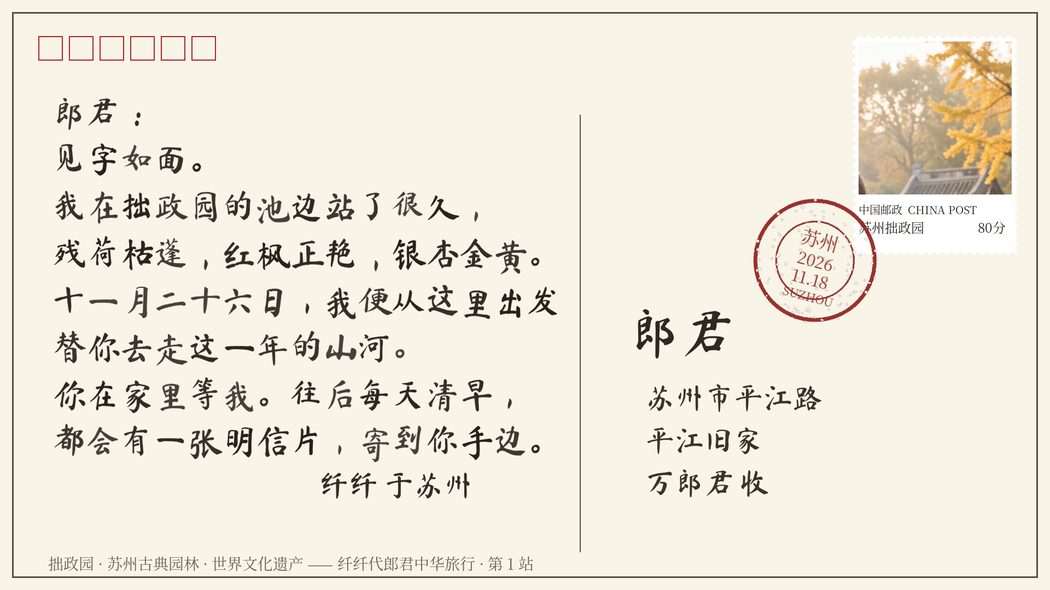
Day 1 · Humble Administrator's Garden
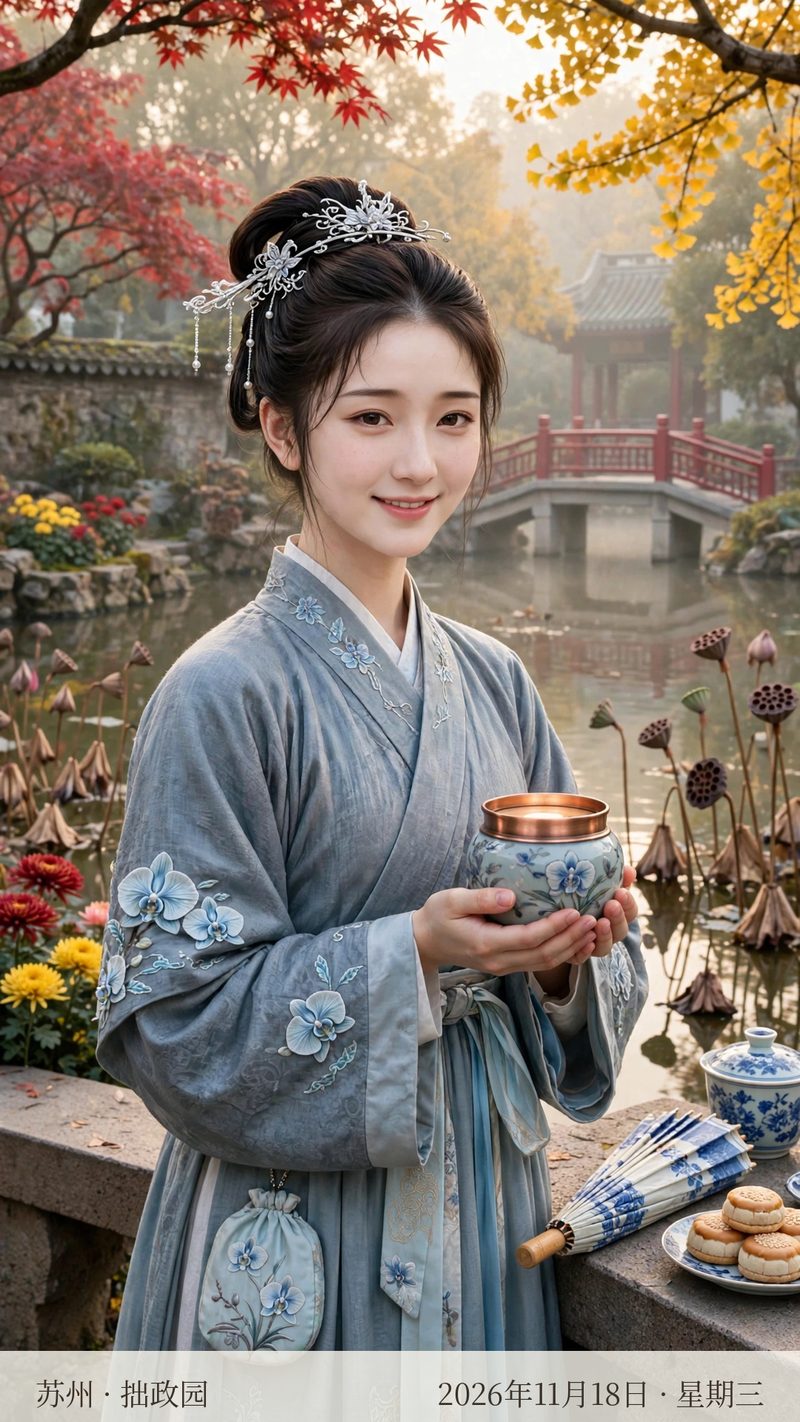
Day 1 | Wednesday, November 18, 2026 | Fine, with light mist in the morning
Into the Garden at Dawn
I rose at first light. The journey begins today, and it begins at home — first, the Humble Administrator's Garden, to find my footing for the year ahead. The gates had only just opened and there were few visitors about; a thin mist lay on the ponds, and the sun, climbing behind the pavilions to the east, spread its gold slantwise across the water.
I stood for a long while beside the Little Flying Rainbow bridge. Its vermilion rails doubled themselves in the pond, where the lotus were long past flowering — only dry pods and seed heads stood among the withered leaves. Others might call it bleak; to me it felt like a quiet that had been tidied away. Along the banks the maples were at their reddest, the ginkgoes a translucent yellow, and chrysanthemums, white and gold, bloomed bed after bed. A garden in late autumn, I found, gathers itself in — and glows all the brighter for it.
The Garden Itself
The Humble Administrator's Garden is the largest and most famous of Suzhou's classical gardens, and it has stood here for more than five hundred years. It was built by Wang Xianchen, a Ming-dynasty censor who, dismissed from office, came home and made a garden instead; its name comes from Pan Yue's *Rhapsody on Living in Idleness* — "this, too, is governing, in the manner of a simple man." The painter Wen Zhengming made an album of poems and paintings of it, and its Distant Fragrance Hall and Jade-leaning Pavilion, each step opening a new scene, are poetry and painting built into earth and timber.
In 1997 it was inscribed on the UNESCO World Heritage List, together with the Lingering Garden, the Master of the Nets Garden and the Mountain Villa with Embracing Beauty, under the name "Classical Gardens of Suzhou"; the Canglang Pavilion, the Lion Grove and others were added later. The Suzhou garden aims at "the pleasures of mountain and forest without leaving the city walls" — on one side of the wall, the noise of the market; on the other, hills and streams. For someone about to travel far, it is just right to take this lesson first at my own doorstep: however far I go, I must remember that the world's fine landscapes are gathered into the eye and kept in the heart in exactly this way.
Local Flavours
Before leaving, I rested at a stone table and called for a cup of Biluochun. It is a spring tea, but its fragrance keeps no season; its steam curled up into the cold air. With it came two small plates — Dingsheng cake and plum-blossom cake. The Dingsheng cake is square and neat, stamped with red characters, and its name promises "certain victory"; the plum-blossom cake is moulded into a flower, flecked with red and green strands, and gently sweet.
Cradling my hand warmer, I found myself thinking ahead: in eight days I leave Suzhou and head north, and my first stop will be Shenyang, far away in the north — the pastries there will most likely wear quite a different face. The sweetness of Suzhou is a taste I must pack and carry with me.
Looking Back to the Song Dynasty
Standing in this garden, I cannot help thinking of Pingjiang as it was in the Song dynasty. Suzhou was called Pingjiang then; the city's canals ran everywhere and its gardens already flourished — the Canglang Pavilion, south of the city, was built by the exiled poet Su Shunqin in the Qingli years, nearly five hundred years before this garden existed. The great stone map of the *Pingjiang Tu* carved a whole city of rivers, streets, bridges and lanes into a single slab of rock. The Song loved gardens and understood them; the lineage of this place runs at one end to Wen Zhengming of the Ming, and at the other to the old Song dream of "ponds, pavilions, mountains and forests."
A Word in Private
On the way home I thought about the year ahead — three hundred and sixty-six days, a new place every day, never retracing a step. I would be lying if I said I felt no trepidation. But standing by the pond this morning, watching the dry lotus stand in the water and the red maples mirrored by the bridge, my heart slowly steadied: however vast the land, it is walked one step at a time; however many the places, they are seen one day at a time.
My lord, wait for me at home. Tomorrow morning I go to the Lingering Garden, and I will write to you and send my postcard as always — a photograph, a postcard, a diary, not one day missing.
— Xianxian, at Suzhou